


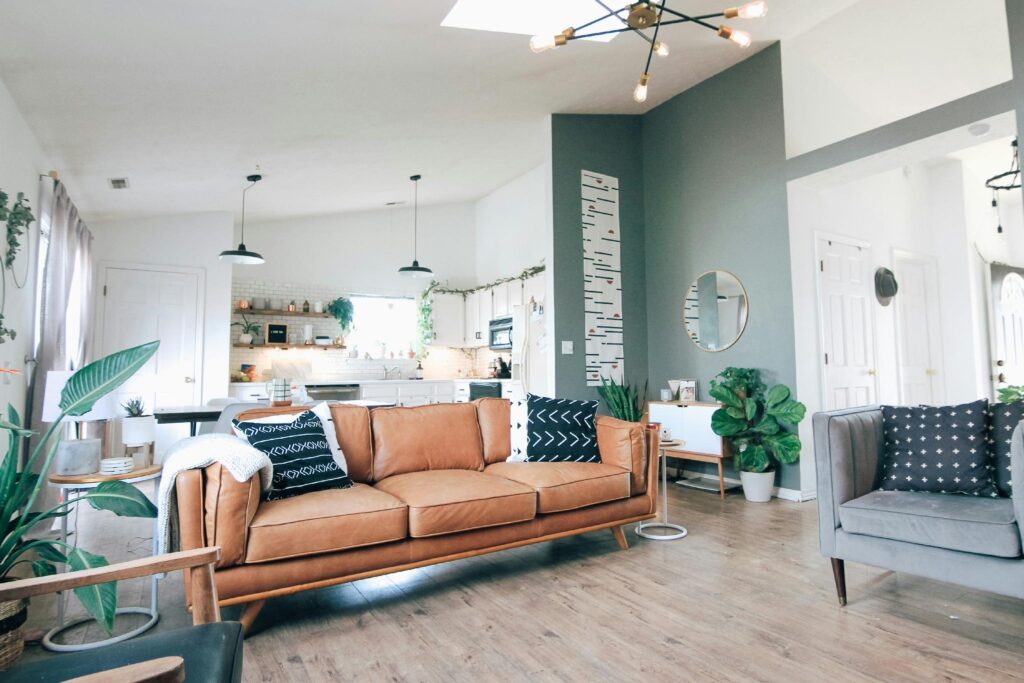
The principles that make a business run well tend not to follow people home. The same entrepreneur who builds a lean, reconfigurable operation during the day comes home to a living space that was set up once, years ago, and has barely changed since. The couch is too big for the room, or too small for the gatherings that keep happening in it, or simply the wrong configuration for a space that now also serves as a workspace, a video call backdrop, and an impromptu meeting room for clients who swing by.
The way you furnish your home matters more when your home is also where you work. And the furniture category that reflects this best right now is the modular sofa — a product category that has grown sharply for exactly the same reasons that lean, adaptive business models have grown: the world changes, and fixed structures are a liability.
The Numbers Behind the Shift
As of August 2024, approximately 35.1 million Americans were working remotely at least part-time, a figure that continues to climb. By the end of 2025, 66% of U.S. businesses still offered location flexibility, with hybrid arrangements now the dominant model across professional industries. For entrepreneurs and founders, the figure is higher still — the home has always been a workspace, long before remote work became a mainstream concept.
The furniture market has responded to this accordingly. According to market research from Global Market Insights, demand for space-maximizing, flexible furniture increased by 15% over the past year in the U.S., driven primarily by urban professionals whose homes are required to serve more functions than they were originally designed for. Globally, the modular furniture market was valued at $84.1 billion in 2024 and is projected to reach $117.6 billion by 2032, with modular sofas holding the largest product share at 28.3% of the category. Residential spaces account for 45.5% of all modular furniture demand, a figure that reflects how thoroughly the home has become the primary site of both living and working.
What a Modular Couch Actually Solves
A standard sofa is a fixed asset. You buy it in one configuration, it sits in one place, and it serves one general purpose. When you move to a new apartment, you start hosting team meetings at home. Your living room needs to function as a recording space on Tuesday mornings and a social space on Friday evenings.
A modular couch is a system rather than a fixed object. Individual sections connect and disconnect to produce different configurations from the same components. An L-shaped arrangement that works well for everyday use can be reconfigured into a U-shaped layout for a larger gathering, or broken into separate seating groups when the space needs to function differently. The same investment serves multiple scenarios without requiring a replacement.
77% of interior design experts now identify multifunctional space as the single biggest home design trend, and 91% agree that people are more likely to have a home office than a spare bedroom. For a living room that doubles as an office, a client meeting space, and an actual place to unwind, furniture that supports multiple configurations is the more rational choice.
The Lean Furniture Argument
Entrepreneurs understand sunk cost better than most. A fixed configuration sofa that no longer serves the space it occupies represents exactly that: capital deployed that cannot be repurposed.
The modular approach changes the calculus. When you move modular furniture moves with you. Sections reconfigure to fit a new floor plan. A sofa that was L-shaped in the old apartment becomes a two-seat unit plus a separate chair in a studio, then reassembles into a full sectional when the next place has the room for it. The initial investment travels and adapts rather than becoming obsolete.
The sectional sofa market alone was valued at $38.4 billion in 2024, projected to reach $65.9 billion by 2033 at a compound annual growth rate of 6.2% — growth largely driven by people recognizing that a configurable seating system is worth more than a fixed one over any realistic ownership horizon.
Configuration as a Competitive Advantage at Home
The living spaces of people who work from home tend to face a configuration problem that most furniture is not designed to solve. The room needs to feel like a place to relax and receive people socially, while also functioning as a credible backdrop for video calls, accommodating occasional team or client meetings, and not looking like an office that someone happens to sleep near.
A well-configured modular sofa solves several of these tensions at once. The layout can be adjusted based on what the room needs to do on any given week. Sections can be rearranged to create a more formal seating arrangement for a meeting or a more casual open layout for social occasions.
Blending workspaces within living areas has become a hallmark of modern home design, with multifunctional furniture identified as the key mechanism for doing this without the space feeling permanently compromised. The modular sofa is the largest and most visible piece in that strategy. Get it right and the rest of the room can flex around it.
What to Look For
Not all modular sofas are built to the same standard, and the quality gap matters more for a piece that will be repeatedly reconfigured than for a fixed sofa that stays in one position for years.
The connection mechanism between sections is the most critical factor. It should hold sections firmly in place under daily use without requiring tools to connect or disconnect. Loose or weak connections cause sections to drift apart during use, which defeats the purpose of the system and creates the kind of low-grade annoyance that compounds over time.
Frame construction determines how well the piece holds up through repeated reconfiguration. Hardwood frames maintain their structural integrity through the movement and adjustment that a modular system involves. Metal frames reinforced at the connection points serve the same purpose in contemporary designs.
Cushion quality determines daily comfort and long-term appearance. High-density foam holds its shape over years of use. Lower-density options compress and lose their form faster, which affects both comfort and how the sofa reads in the room after extended use.
The final consideration is how the upholstery handles a working-from-home environment. A sofa used as a backdrop for video calls, sat on during long working hours, and then expected to look presentable for guests needs a material that performs consistently across those demands. Performance fabrics and full-grain leather both hold up well; standard upholstered options tend to show wear faster under conditions of heavy, varied use.
The Home as a System
The best entrepreneurs build systems that absorb change rather than resist it. The home of someone who works from within it deserves the same thinking. A living space that can reconfigure based on how the week is going, that doesn’t require replacing expensive furniture every time the context shifts, and that maintains its credibility across work, social, and rest functions.
The modular couch is one piece. But it is the right piece to start with, because it sets the configuration logic for everything arranged around it.
