


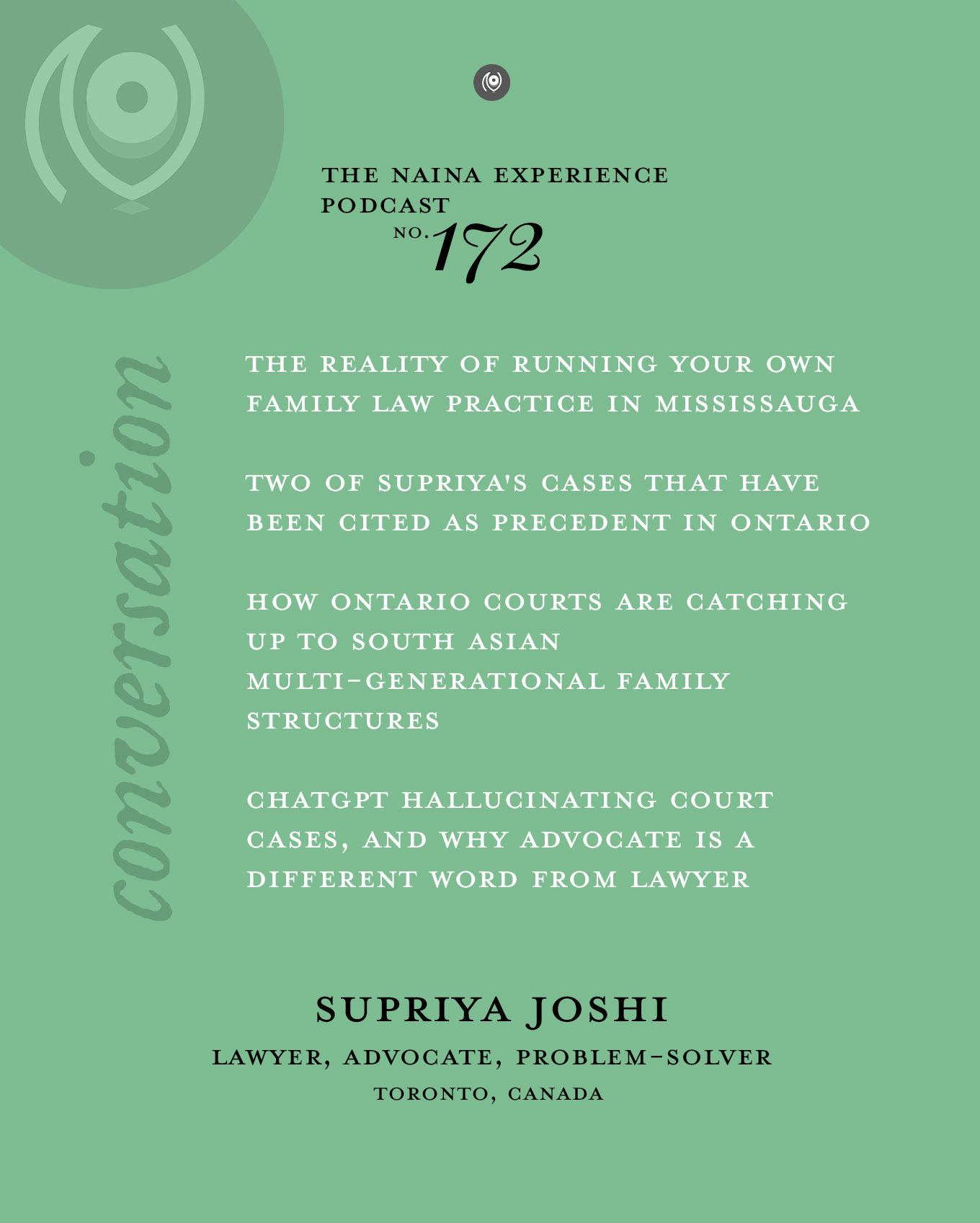
Supriya Joshi is a family law lawyer in Mississauga, in the Greater Toronto Area. She graduated from Windsor Law in 2016, was called to the Bar in 2017, and is registered with the Law Society of Ontario. She practices at Subhash Joshi Law Professional Corporation on Drew Road, and she focuses exclusively on family law and litigation – divorce, property division, spousal support, and the personal end of relationship breakdowns.
Supriya and I have known each other for years. We met because of a shared love of Suryagarh in Jaisalmer – she emailed me after seeing one of my Instagram posts from there, ended up buying brooches, a hand-painted baseball cap, and the Indian tote bag she still uses. When she next travelled to Delhi we met in person, she brought me a bottle of wine from Toronto, and we have since travelled together in Rajasthan and to Maheshwar. This is episode 172 of the podcast and she is the first lawyer to come on.
We started with the reality of running your own practice. The admin part. The delegation problem. Supriya was direct about hiring in her area being harder than it looks, because family law clients are dealing with the breakdown of a relationship and there is a sensitivity layer on top of the legal work. A great lawyer who is a crappy person is not the right fit.

Her interest in World War II came up early. Her grandfather was in the Indian Air Force, his father served during the British Raj, and her great-grandfather fought in Burma in the Second World War. A grade 10 history teacher named Mr. Stroud sealed it. Since then she has visited most of the Western Front and a lot of the Eastern Front, and she keeps an RAF air mask from the Second World War on her desk. She is going to Normandy and Dunkirk again in a few weeks for a friend’s 40th birthday in France. She made the point that having something separate from work is what keeps you from burning out. A mentor told her early on – do not let what you do be who you are.
On the law itself, Supriya talked through two cases she argued that have since been cited. One was a spousal support claim from a short marriage that involved extreme violence and a relocation. By the guideline she was going to get nothing. Supriya brought it as an urgent motion and won, and the judge’s commentary on what counts as moving for the purposes of a marriage has been reported and cited several times. The second was a jurisdictional question – which province a case is properly seated in – that turned on whether the law required an application to be issued, or issued and served. Her client issued first but had not served. She argued issuance alone was enough. She won, and that one has also been cited.
We spent a long time on cultural competence in family law. The Ontario courts are working through how the law applies to South Asian multi-generational families – joint ownership structures where a wife says everything went into a property neither she nor her husband holds title to, family violence presenting in different forms, and the question of whether large sums from parents to adult children are loans or gifts. In South Asian families, parents paying for an adult child’s education or wedding without expectation of repayment is normal. The law is now catching up to that.

The conversation moved to AI. Supriya has had to read submissions where the cited cases simply did not exist – fully hallucinated by ChatGPT. After courts started reprimanding lawyers for not checking, the new version of the problem is real cases with fabricated quotes attached to them. She was clear that AI is a starting point and is here to stay, but it is not a substitute for a lawyer, and she pointed out that when the hyphens and the random bolded words show up in an email from opposing counsel, she knows exactly where it came from. Confidentiality also keeps her from putting client material into a public model, which is why firms like Smoke Ball in Australia are building closed AI tools specifically for law.
She uses the word advocate as a separate word from lawyer. Lawyer is knowing the law and the procedure. Advocate is the human part, and that part she does not think AI replaces.
She also writes emails for fun. Plans itineraries the way other people plan businesses – flight to flight, car, license plate, what she is having for lunch in Delhi on June 16th. She did the logistics for her brother’s wedding in India. The chaos of the professional life is paradoxed by the structure of the personal one.
She is back in India on June 14th.
Guest Links:
Supriya Joshi on LinkedIn: Supriya Joshi – Legal Aid Ontario directory: Subhash Joshi Law Professional Corporation: 1530 Drew Road Suite 30, Mississauga, ON L5S 1W8
Naina’s Links:
Book the podcast: https://www.naina.co/product/the-100-podcast/
Instagram: https://www.instagram.com/naina
Website: https://www.naina.co
Spotify: https://open.spotify.com/show/5HwVipVYnxARyEjp4onfvp
YouTube:
Watch the full episode on YouTube & Spotify
