
Close Menu
Decapitalist

    Subscribe to Updates

    Get the latest creative news from Decapitalist about Politics, World News and Business.

    Please enable JavaScript in your browser to complete this form.
    Loading
    What's Hot

    REVIEW: Waldorf Astoria Riviera Maya, A Luxury Escape Near Cancun

    April 30, 2026

    Sabreen Haziq, Building Brand Equity on LinkedIn from Boston

    April 30, 2026

    Evangeline Lilly Calls Disney’s Marvel Layoffs “Disgusting And Horrible”: “Shame On You”

    April 30, 2026
    Facebook X (Twitter) Instagram
    Facebook X (Twitter) Instagram
    Decapitalist
    • Home
    • Business
    • Politics
    • Health
    • Fashion
    • Lifestyle
    • Sports
    • Technology
    • World
    • More
      • Fitness
      • Education
      • Entrepreneur
      • Entertainment
      • Economy
      • Travel
    Decapitalist
    Home»Lifestyle»150-million-year-old intact dinosaur eggs found on Portugal’s Santa Cruz Beach, where a Jurassic predator left them |
    Lifestyle

    150-million-year-old intact dinosaur eggs found on Portugal’s Santa Cruz Beach, where a Jurassic predator left them |

    Decapitalist NewsBy Decapitalist NewsMarch 9, 2026024 Mins Read
    Share Facebook Twitter Pinterest Copy Link LinkedIn Tumblr Email Telegram WhatsApp
    Follow Us
    Google News Flipboard
    150-million-year-old intact dinosaur eggs found on Portugal’s Santa Cruz Beach, where a Jurassic predator left them |
    Share
    Facebook Twitter LinkedIn Pinterest Email Copy Link


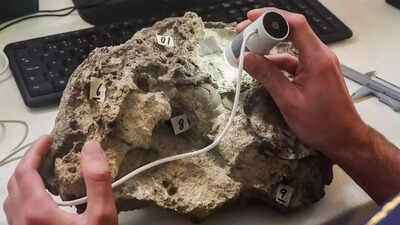
    150-million-year-old intact dinosaur eggs found on Portugal’s Santa Cruz Beach, where a Jurassic predator left them
    PC: Natural History Society based in Torres Vedras, Portugal

    Dinosaurs are one of those species that have never been seen in real life by anyone; everyone has grown up seeing dinosaurs only in movies like Jurassic Park and reading about them in school books or novels. According to the U.S. Geological Survey (USGS), the biological reality of dinosaurs is that they were last seen on Earth approximately 66 million years ago after living on this planet for about 165 million years. But now, on the cliffs of Santa Cruz beach located in the municipality of Torres Vedras (Lisbon district), Portugal, a nest containing 10 dinosaur eggs have found after 150 million years.This remarkable finding was made by Carlos Natário, an associate researcher at the Centre for Research in Paleobiology and Paleoecology (Ci2Paleo), which works under the Torres Vedras Natural History Society (SHN) in Torres Vedras, Portugal. Their preliminary observations indicate that the hatchlings successfully emerged from the eggs millions of years ago. However, researchers believe traces of unborn baby dinosaurs (embryos) may still be preserved in some of the shells inside.

    10 intact dinosaur eggs were uncovered in a 150-million-year-old nesting site

    Inside the cliffs of Santa Cruz Beach in Torres Vedras, Portugal, researchers found a very rare thing from the Upper Jurassic era. A tiny nest containing 10 dinosaur eggs, which undoubtedly offers a very rare glimpse into the prehistoric life from 150 million years ago. One of the most scientifically significant findings is that the eggs were not moved by any ancient floods or natural disasters. These eggs are found in the nesting pattern only, which gives an idea that the Jurassic predator must have chosen the riverbank location to lay its eggs. According to the team at Ci2Paleo, several specific conditions had to be met at the exact moment the eggs were laid:

    • Researchers found the eggs in a granular sandstone, which confirms that the predator likely laid the eggs on a riverbank. This soft sand helped the eggs to stay gently buried by natural sediment shortly after they were laid.
    • One of the major findings in the Torres Vedras Natural History Society (SHN) report is that the eggs were not moved by water. In such cases, eggs get vanished by floods or any other natural disaster. Scientists believe that they were fossilised at the same location where the mother left them. No movement in the eggs helped them in remaining intact rather than becoming a pile of fragments.

    From fossils to CT scans

    The moment eggs were discovered at Santa Cruz Beach was just the announcement; now the heavy sandstone block containing the nest has been taken to the Torres Vedras Natural History Society (SHN) laboratory for a “virtual excavation.” To understand and read the eggs from the inside without harming them, researchers perform CT scans. This non-harming advanced technique allows scientists to have a high-resolution 3D model of the interior.

    The goal of the CT scans is to resolve two major scientific mysteries

    • Many of the eggs showed signs that the babies inside the eggs had successfully emerged; there may still be signs of embryonic bone.
    • By measuring the structure from inside and the microscopic porosity of the shells, researchers can find out which Jurassic predator laid the eggs.

    What kind of dinosaur laid these eggs

    As of now, the exact species is still unknown as it’s under analysis. Preliminary studies of eggshells strongly suggest that eggs belong to a carnivorous theropod. The eggs are small in size, measuring barely 5 centimetres in diameter. These are the two-legged predators of the Jurassic era. As the eggs are found in a three-dimensional nest, this specific type of nesting behavior common in meat-eating dinosaurs.


    Source link

    10 intact dinosaur eggs 150millionyearold Beach Cruz dinosaur Dinosaur eggs Eggs intact Jurassic Jurassic predator left Portugals predator Santa Santa Cruz Beach Santa Cruz Beach Portugal
    Follow on Google News Follow on Flipboard
    Share. Facebook Twitter Pinterest LinkedIn Tumblr Email Copy Link
    arthur.j.wagner
    Decapitalist News
    • Website

    Related Posts

    Poetry Month Reading Recommendations – The New York Times

    April 30, 2026

    King Charles full schedule today for US state visit after White House dinner with Trump and Congress speech

    April 29, 2026

    4 harmful effects of screen time on child development

    April 28, 2026
    Add A Comment
    Leave A Reply Cancel Reply

    Top Posts

    Coomer.Party – Understanding the Controversial Online Platform

    August 8, 2025961 Views

    Which country doesn’t have a capital city, and why? |

    November 30, 202599 Views

    Poilievre says of B.C. premier that ‘one man can’t block’ pipeline proposal

    August 8, 202580 Views
    Don't Miss

    Oil jumps to highest price since 2022 after report Trump to be briefed on new Iran options

    April 30, 2026 Business 01 Min Read2 Views

    “It does seem as though escalation in the war is back on the table, be…

    Starbucks (SBUX) Q2 2026 earnings

    April 29, 2026

    Exports decline 7.14% in nine months

    April 28, 2026

    oil hits $107 mark, markets shaken by deepening Iran-US deadlock

    April 27, 2026
    Stay In Touch
    • Facebook
    • YouTube
    • TikTok
    • WhatsApp
    • Twitter
    • Instagram
    About Us

    Welcome to Decapitalist — a post-capitalist collective dedicated to delivering incisive, critical, and transformative political journalism. We are a platform for those disillusioned by traditional media narratives and seeking a deeper understanding of the systemic forces shaping our world.

    Most Popular

    REVIEW: Waldorf Astoria Riviera Maya, A Luxury Escape Near Cancun

    April 30, 2026

    Sabreen Haziq, Building Brand Equity on LinkedIn from Boston

    April 30, 2026

    Subscribe to Updates

    Please enable JavaScript in your browser to complete this form.
    Loading
    • About Us
    • Contact Us
    • Disclaimer
    • Privacy Policy
    • Terms and Conditions
    Copyright© 2025 Decapitalist All Rights Reserved.

    Type above and press Enter to search. Press Esc to cancel.