
Close Menu
Decapitalist

    Subscribe to Updates

    Get the latest creative news from Decapitalist about Politics, World News and Business.

    Please enable JavaScript in your browser to complete this form.
    Loading
    What's Hot

    NPS rules explained: Key changes that make it more than just a tax-saving instrument | Personal Finance News

    February 20, 2026

    Pete Davidson’s girlfriend Elsie Hewitt says ‘everything hurts’ after sudden medical emergency

    February 20, 2026

    Cats may hold clues for human cancer treatment

    February 20, 2026
    Facebook X (Twitter) Instagram
    Facebook X (Twitter) Instagram
    Decapitalist
    • Home
    • Business
    • Politics
    • Health
    • Fashion
    • Lifestyle
    • Sports
    • Technology
    • World
    • More
      • Fitness
      • Education
      • Entrepreneur
      • Entertainment
      • Economy
      • Travel
    Decapitalist
    Home»Education»What American Education Reformers Can Learn from England
    Education

    What American Education Reformers Can Learn from England

    Decapitalist NewsBy Decapitalist NewsFebruary 19, 2026004 Mins Read
    Share Facebook Twitter Pinterest Copy Link LinkedIn Tumblr Email Telegram WhatsApp
    Follow Us
    Google News Flipboard
    What American Education Reformers Can Learn from England
    Share
    Facebook Twitter LinkedIn Pinterest Email Copy Link


    Veterans of mid-noughties Finland mania may look askance at any PIRLS/PISA-based boosterism of a national education system. After all, in the wake of Finland’s stellar performance on the inaugural round of PISA testing in 2003, a whole industry sprang up devoted to studying, venerating, and emulating the purported drivers of Finnish excellence. Yet as of 2022—the latest round of PISA testing—Finland’s performance had declined more than any other country.

    The case of Finland is a good reminder of Jay Greene’s maxim that “best practices are the worst” and that selecting on the dependent variable (i.e., studying only successful cases when attempting to discern the drivers of success) is sloppy social science.

    But the English story differs in at least three respects from the just-so tales and spurious projections onto domestic debates that Finland engendered some 15 years ago. And Gibb and Peal’s Reforming Lessons is not just a bit of post-hoc self-aggrandizement from a retired politician and his former factotum.

    First, a hallmark of good social science is the “pre-registration” of hypotheses before experimentation. Unlike Finland, the authors of England’s reforms posited their theory of change ex ante. Gibb, together with Michael Gove (the Secretary of State for Education until 2014), assumed office in 2010 with a detailed program for reform. The key planks of the plan included raising entry standards for publicly funded teacher training programs and the expansion of Teach First (the British analog of Teach for America); mandating systematic synthetic phonics; adopting a K–12 curriculum organized around recognized disciplines and bodies of knowledge; overhauling examinations and accountability measures and norming them to the most rigorous education systems worldwide; promoting teacher-led, explicit instruction; supporting stronger school discipline; and a massive expansion of academies and free schools (akin to charters).
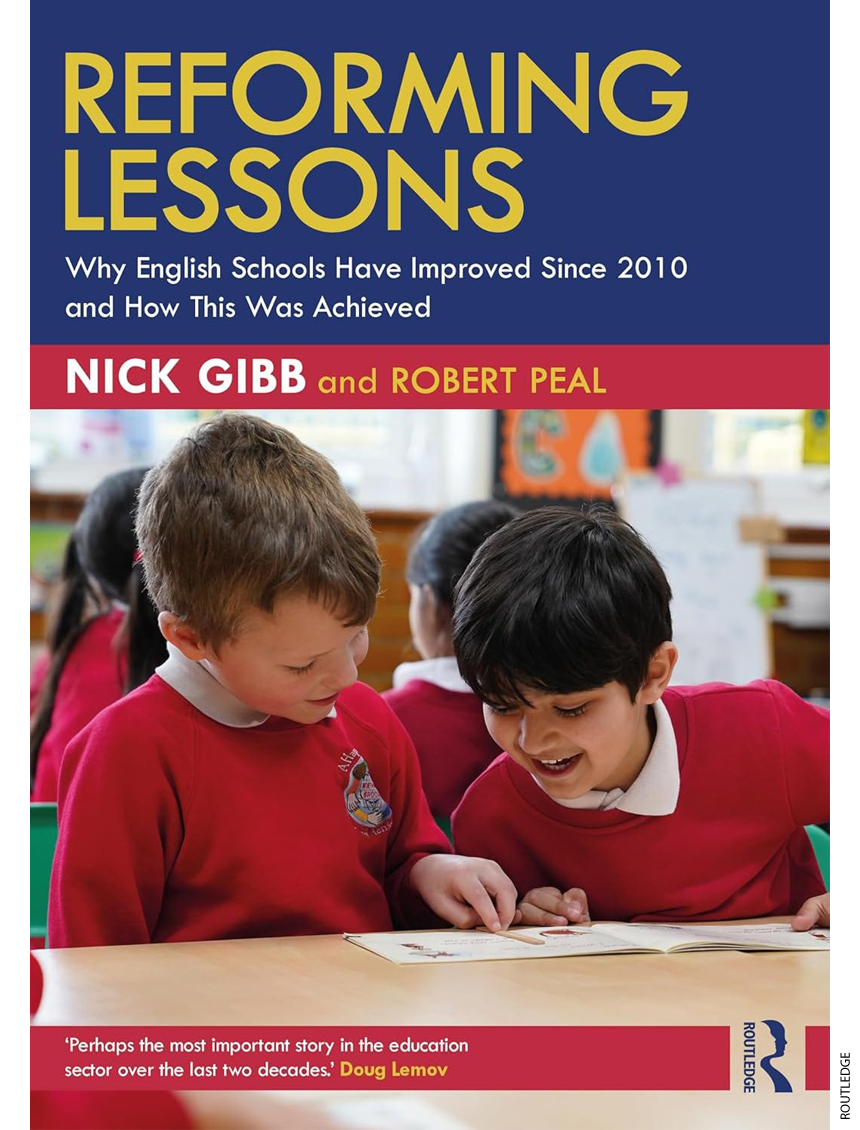
    Book cover of "Reforming Lessons: Why English Schools Have Improved Since 2010 and How This Was Achieved"
    Reforming Lessons: Why English Schools Have Improved Since 2010 and How This Was Achieved
    by Nick Gibb and Robert Peal
    Routledge, 2025, $21.59, 262 pages

    Undergirding this platform was an abiding conviction that a “Rousseauian ideology of progressive education was the fundamental problem in English schools. From the teaching of reading and maths, to the content of the wider curriculum, to pedagogy in the classroom, not to mention classroom configuration and behavior policy, ideological progressivism was driving practice. And it was failing.” Overhauling this orthodoxy, they posited, would arrest England’s “slide down the world league tables in reading, mathematics and science.”

    In Finland, by contrast, no such evaluation or responsive action took place. In the wake of its 2003 PISA triumph, prominent exponents of the Finnish model blithely asserted that they “never set out to win a high ranking among the nations. That just happened.” Finland’s performance nonetheless occasioned no shortage of post-facto explanation—much of it unsubstantiated, if not entirely spurious.

    Second, the English system steadily improved over more than a decade, and this improvement aligns temporally with the major reforms of the Gibb-Gove era. Finnish mania, on the other hand, was sparked by a single snapshot (the 2003 PISA results) from which no solid causal inferences could be drawn.

    Finally, comparative data further bolsters the claim that Gibb and co.’s reforms positively affected the quality of English schools. Between 2010 and 2024, the constituent nations of the United Kingdom ran something of a natural experiment in education policy. While England embraced phonics, a knowledge-rich curriculum, explicit teacher-led instruction, and greater school autonomy, Scotland and Wales eschewed the evidence on early literacy instruction, doubled down on national curricula focused on the acquisition of amorphous “generalizable” skills, and promoted self-directed “discovery” learning as state of the art. During this period, the international metrics show that England forged ahead, while its fellow home nations stagnated (see Figure 2).

    Strangely, London’s gritty outer boroughs and the dowdy post-industrial towns of northern England haven’t attracted the same levels of edu-tourism and breathless fascination that Finland garnered in its heyday. That’s probably for the best. But aspiring reformers the world over would do well to familiarize themselves with the English example. Indeed, several already have to apparently good effect. What, then, are the key English lessons?


    Source link

    American Education education reform education reform books England England schools Finland Great Britain Helen Baxendale International international benchmarking international comparisons international competition international education international rankings international students learn Nick Gibb PIRLS PIRLS test PISA PISA Test PISA tests Reformers Reforming Lessons Reforming Lessons: Why English Schools Have Improved Since 2010 and How This Was Achieved Robert Peal Sir Nick Gibb The International PISA Test United Kingdom
    Follow on Google News Follow on Flipboard
    Share. Facebook Twitter Pinterest LinkedIn Tumblr Email Copy Link
    arthur.j.wagner
    Decapitalist News
    • Website

    Related Posts

    South American theft ring hits 60+ Houston homes using signal jammers

    February 20, 2026

    How Vietnam’s bilingual schools actually work

    February 18, 2026

    South Carolina measles control efforts hamstrung by holiday school closures

    February 17, 2026
    Add A Comment
    Leave A Reply Cancel Reply

    Top Posts

    Coomer.Party – Understanding the Controversial Online Platform

    August 8, 2025948 Views

    Poilievre says of B.C. premier that ‘one man can’t block’ pipeline proposal

    August 8, 202580 Views

    ‘Even Warren Buffett Has Accepted…’: Robert Kiyosaki Warns Investors Of Major Shock Ahead | Markets News

    October 2, 202544 Views
    Don't Miss

    NPS rules explained: Key changes that make it more than just a tax-saving instrument | Personal Finance News

    February 20, 2026 Business 02 Mins Read1 Views

    New Delhi: The National Pension System (NPS) is no longer just a tax-saving instrument. Recent…

    How ICE Is Pushing Tech Companies to Identify Protesters

    February 19, 2026

    John Lewis and Waitrose shop staff set for significant pay hike

    February 18, 2026

    Stock market today: Nifty50 opens below 25,600; BSE Sensex drops over 200 points

    February 17, 2026
    Stay In Touch
    • Facebook
    • YouTube
    • TikTok
    • WhatsApp
    • Twitter
    • Instagram
    About Us

    Welcome to Decapitalist — a post-capitalist collective dedicated to delivering incisive, critical, and transformative political journalism. We are a platform for those disillusioned by traditional media narratives and seeking a deeper understanding of the systemic forces shaping our world.

    Most Popular

    NPS rules explained: Key changes that make it more than just a tax-saving instrument | Personal Finance News

    February 20, 2026

    Pete Davidson’s girlfriend Elsie Hewitt says ‘everything hurts’ after sudden medical emergency

    February 20, 2026

    Subscribe to Updates

    Please enable JavaScript in your browser to complete this form.
    Loading
    • About Us
    • Contact Us
    • Disclaimer
    • Privacy Policy
    • Terms and Conditions
    Copyright© 2025 Decapitalist All Rights Reserved.

    Type above and press Enter to search. Press Esc to cancel.