


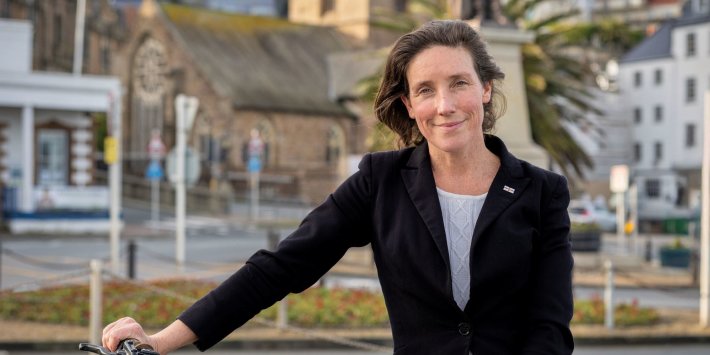
Lindsay de Sausmarez, chief minister of Guernsey (Langlois Photography)

9 min read
Lindsay de Sausmarez is head of Guernsey’s government. She tells Noah Vickers about the island’s demographic challenge, the impact of Brexit and Westminster’s demand for more financial transparency
“This is my personal theory: I like to think it’s down to our exceptional milk,” says Lindsay de Sausmarez, chief minister of Guernsey. “We have very good milk here – the best in the world.”
The island’s people, de Sausmarez explains, are living longer. Life expectancy in Guernsey is 82 for men and 85 for women, respectively three and two years longer than the UK.
With that trend come social and economic challenges to which de Sausmarez has been charged with responding.
The 48-year-old mother of four, who has a background in the creative industries, was elected to the island’s parliament, the States of Guernsey, in 2016. Like most of her colleagues, she is an independent and is reluctant to put a label on her ideology, saying it is “very difficult to overlay Guernsey politics over the UK system”. Online quizzes, however, tend to place her “bang in the middle” of the political spectrum.
In the summer of last year, de Sausmarez made history by becoming Guernsey’s first female chief minister. Officially, her title is President of the Policy and Resources Committee, as Guernsey’s government does not have a cabinet system and instead operates through committees.
“To be completely honest, it wasn’t a role I’d been eyeing up at all,” she tells The House. “I’d been very happy in my previous role, but we have a system where we go where the parliament thinks you can do the most good.”
Her elevation to the top job comes at a critical chapter in Guernsey’s politics, as she and her colleagues grapple with a health system in need of financial reform, a lack of affordable housing and unsustainable tax arrangements.
Guernsey, like Jersey and the Isle of Man, is a Crown Dependency, meaning it is not part of the UK and is almost entirely self-governing, with no MP representing it in Westminster. The UK is responsible only for its defence and international relations.
Guernsey, therefore, is not part of the NHS, and islanders must pay for primary care such as GP visits, prescriptions, A&E treatment and ambulances. Secondary or specialist care is covered by the public purse. According to a BBC analysis, the average cost of seeing a GP in Guernsey is £73.
But with the ageing population, de Sausmarez’s government has warned that “health and care services risk becoming overburdened and financially unsustainable”. The States of Guernsey will agree a new funding model over the current parliament.
Insurance-based systems of the kind used in some EU countries will be examined as part of that work, she says, as will elements of the UK’s system, while acknowledging that Guernsey is “never going to be able to directly replicate” how the NHS works.
“We are very fortunate in that we don’t have many of the problems that are experienced in the UK system,” de Sausmarez points out.
“For example, there was quite a wonderful complaint a month or two ago, where someone complained that they had to wait up to 15 minutes in A&E to be seen. There are many in the UK’s health system who would give their right arm for problems like that.”
Getting more homes built is another priority: “Unlike a town of a similar size in the UK, you can’t just jump on a train to commute in, so we have particularly high housing costs here because space is at an absolute premium.”
The average price of a home in Guernsey is almost £600,000. The island’s government has pledged to commence development at a site it owns called Leale’s Yard, with capacity for more than 300 new properties.
[Brexit] was frustrating for us, because we had no say in the referendum
Brexit has also brought challenges. The Crown Dependencies were never formally part of the EU but were deeply enmeshed in it as they belonged to the bloc’s customs territory. They also enjoyed free movement of goods with Europe, albeit without the single market’s other three freedoms of movement relating to people, services and capital. With the UK’s departure, those arrangements ceased.
“It was frustrating for us, because we had no say in the referendum that led to us [feeling those impacts],” de Sausmarez says. “But it affected us very materially. We’ve had to devote very significant resource to adjusting to a post-Brexit world.”
Should the Crown Dependencies have been given a vote in the referendum, as the British Overseas Territory of Gibraltar was?
“I think many people would have welcomed a vote, because it did affect us so much,” the chief minister replies. “But we didn’t, and there’s no point in dwelling in the past.”
Gibraltar, which was allowed to vote because it was fully part of the EU, plumped for remain by 96 per cent. Would the result have been similar in Guernsey?
De Sausmarez “wouldn’t like to speculate” on that, though from personal conversations she had at the time, she thinks islanders’ views on the issue fell “quite stereotypically along generational lines”.
She adds that Guernsey was “as well-prepared for the result of that vote as we possibly could have been” and points out that Brexit also has brought some benefits.
“We now have control of our territorial waters up to 12 nautical miles. That’s a very helpful thing in terms of our offshore wind and our marine renewable energy aspirations.”
Guernsey has nevertheless taken a “very keen interest” in the UK-EU reset negotiations and has made clear to the UK government that it wants to be included if a youth mobility scheme is agreed.
The island’s tax system, meanwhile, is overdue for reform. Guernsey has no VAT, no inheritance tax and no capital gains tax. Income tax is set at a flat rate of just 20 per cent.
For several years, the island’s government has been spending more than it receives in revenues and has relied on historical reserves to deliver public services. With financial pressures expected to “only intensify”, the States of Guernsey has committed to agree and implement “a final decision” on a future tax regime before the island’s next election.
“There’s long been a recognition, for the most part, that we do need to put our public finances on a stronger and sustainable footing,” de Sausmarez says.
“It’s really a question of how it’s done, and that’s where the political rubber hits the road. It’s a very difficult one. No one, ultimately, wants to pay more tax – that’s just human nature.”
Guernsey remains an attractive location for offshore banking and fund management. Is it fair to call the island a ‘tax haven’, as many in the UK would see it?
“It’s not in any way accurate at all,” de Sausmarez replies. She accepts the island is a “low-tax jurisdiction”, but when it comes to suggestions of financial crime she points to an evaluation last year by Moneyval – the Council of Europe’s anti-money laundering body – which awarded pass ratings to Guernsey in six out of 11 categories.
While the report praised Guernsey for its implementation of targeted sanctions against the financing of terrorism and weapons of mass destruction, it warned the island’s government that “fundamental” work was needed to improve the way it investigates, prosecutes and convicts money laundering offences.
De Sausmarez insists her government is “actively investing” in such improvements and takes the issue “very seriously”, while acknowledging that small jurisdictions like Guernsey will always face an “inherent challenge with the rate of prosecutions”.
In Westminster, meanwhile, Labour is heaping pressure on the Crown Dependencies to be more transparent about the ownership of companies registered in the islands. None of the dependencies have publicly accessible ‘registers of beneficial ownership’, which has become a growing source of frustration for the UK.
In its 2025 Anti-Corruption Strategy, the UK government said it expects the islands to introduce “broad and inclusive” access to the registers for those who have a “legitimate interest” in viewing them – such as journalists, academics and civil society organisations. The UK says it “anticipates” that the dependencies will have introduced this change by July this year, and that this will merely be an “interim step” towards fully publicly accessible registers.
The States of Guernsey will soon launch a consultation on how that interim change could be implemented.
Is de Sausmarez confident of Guernsey meeting the July deadline? “We can make it happen, but [not] until we’ve carried out the consultation. It’s really important that it’s workable – that’s why we’re undertaking a consultation – but we’re very much hoping to make it happen as quickly as we possibly can.”
She adds that the issue was discussed “in some detail” with Justice Secretary David Lammy at a meeting in December 2025.
According to a briefing note from the island’s government, shared with The House, Guernsey “has repeatedly expressed concern about the UK government’s suggestion that legitimate interest access to beneficial ownership registers should, in its opinion, be fully implemented by July 2026”.
It adds that while Guernsey “shares the objective of the UK… in seeking to fight all forms of financial crime”, the UK government should “continue to respect the constitutional status of the Crown Dependencies and avoid attempting to take unilateral actions which seek to impose UK parliamentary decisions or will upon Guernsey”. Failure to do so “would cause unprecedented constitutional problems”, it warns.
The matter is certain to be discussed at the UK’s Countering Illicit Finance Summit in June this year, just weeks before the July deadline.
As far as full public access to the registers is concerned, meanwhile, a spokesman for neighbouring Jersey tells The House that such a move “would not be compatible with Jersey’s international obligations, including those enshrined in its domestic laws”.
The Crown Dependencies point to a 2022 decision by the European Court of Justice, which found public registers to be incompatible with the rights to privacy and the protection of personal data.
De Sausmarez stresses, too, that Guernsey’s register of beneficial ownership has higher standards of verification and due diligence than the UK’s, and that full public access to it cannot be introduced on a whim.
“We’re not trying to hide anything,” she says. “We’re just trying to make sure that it actually works, because you can’t pick up something from another jurisdiction with a very different system, superimpose it on ours, and expect it to work.”
Responding, a Home Office spokeswoman tells The House: “As responsible international financial centres with close ties to the UK, the Crown Dependencies have an important role in championing high standards globally to reduce illicit finance.
“Our approach is collaborative and focused on practical delivery. The Anti-Corruption Strategy sets expectations, and we are working through them together.”
