


Politics
/
January 21, 2026
Nothing says “I care about working people” like a speech to an audience of billionaires at an exclusive Swiss ski resort.
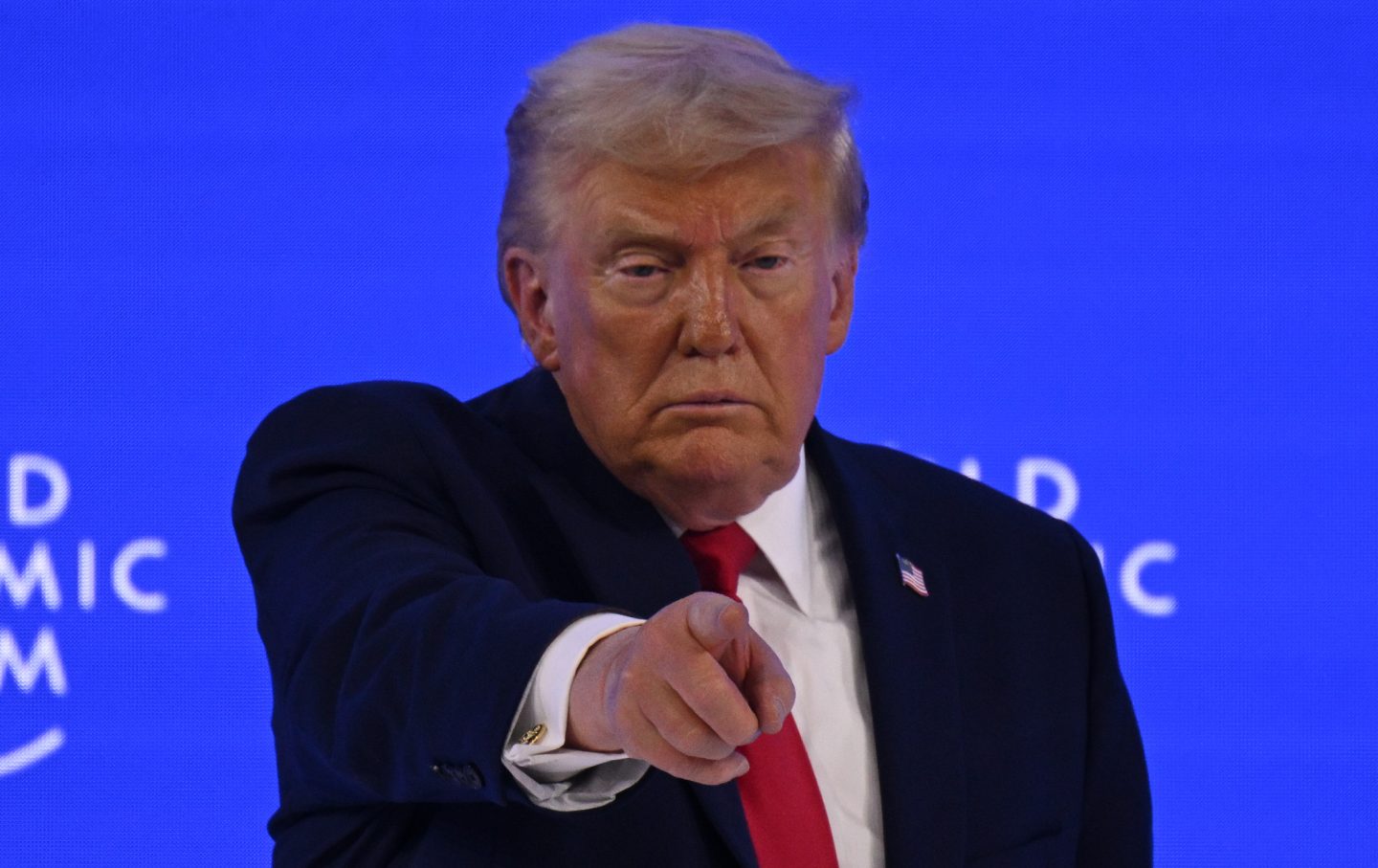
Donald Trump attends the World Economic Forum Annual Meeting in Davos, Switzerland, on January 21, 2026.
(Harun Ozalp / Anadolu via Getty Images)
As President Donald Trump seeks to force the attendees of the World Economic Forum in Davos to submit to his fever dreams of imperial expansion, he also faces a more stubborn, far less operatic challenge to his grip on domestic power. The American public has turned on his presidency, chiefly because Trump has failed to deliver on his central campaign promise to make the US economy more equitable and less inflationary. In belated recognition of this looming threat, Trump gave us one of the more unlikely spectacles in a presidency overstuffed with improbabilities: He delivered an aspirationally populist address before an audience of billionaires at an exclusive Swiss ski resort.
The president’s rallying cry was aspirational for the same reason that his economic agenda is flailing: He and his party have no abiding interest in advancing an economic program that would actually benefit working-class Americans. And Trump, being Trump, has refrained from devoting any serious thought or attention to deep and lasting economic reforms. Instead, he’s pushed a series of gimmicky policy responses that amount to opportunistic photo-ops at best, and cynical afterthoughts at worst. He’s pressured banks to cap credit card fees at 10 percent for the next year—a measure that, at first glance, would seem to offer relief for debt-strapped Americans, but that, in the absence of other meaningful banking and credit regulation, would create the perverse effect of restricting access to credit for the working people who need it the most. One industry analysis found that a 10 percent cap would deny credit to anyone whose credit rating is below 740—some 175 million to 190 million consumers. That’s why Trump’s deadline for bank compliance came and went this Tuesday without any lenders falling into line—and why, during his Davos speech, he said he’d ask Congress to move legislation to formalize a 10 percent cap.
Yet even full compliance would produce only partial debt relief for most borrowers—because the top-heavy credit and banking industries are able to collude to keep merchant fees high, enforce punitive penalties for late payment, and charge annual fees to consumers. And like most of Trump’s symbolic sops to working-class voters—notably his campaign pledges to suspend taxes on tips and allow write-offs on the interest paid on car loans—the credit card cap comes with a hard deadline, which in all cases arrives shortly after the 2026 midterm elections. They are, in other words, simple campaign stunts meant to artificially jolt the electorate into a state of pseudo-populist gratitude; meanwhile, the grievous tax cuts to the rich enacted in Trump’s signature spending and taxation bill last year are permanent, and represent the largest upward distribution of wealth achieved by any piece of legislation in American history. Seizing on the attention to the issue generated by Trump’s proposal, Senators Bernie Sanders and Josh Hawley have produced a more substantive bill to cap fees for five years while enacting broader structural reforms to the credit market—a revived version of the bill the two senators introduced to no avail in 2024. But this measure will likely stall out for the same reason as it did two years ago —Congress is in thrall to the banking lobby. (For confirmation of this, see the banking sector’s full court press to kill off a provision in a pending crypto bill that would permit stablecoins to pay our competitive interest fees in the form of an annual bonus to coin owners.)
Trump’s other hasty and half-baked bid to be seen as a populist tribune of working America also got a passing mention in his speech in Davos: a proposal to bar institutional investors from owning blocs of single-family homes. Like the credit card gambit, this plan seems sensible at first: big private equity and hedge funds are major players in the housing market and, unlike single home owners, they can use their vast stores of capital to wait out passing convulsions in costs, and realize optimal returns on investment, all while passing on expenses to renters, mobile home tenants, and other hapless consumers.
In his Davos remarks, though, Trump underlined that his housing plan won’t aim to expand the nation’s existing housing supply—the most obvious remedy to lower costs for working Americans. “If I really wanted to crush the housing market, I could do that so fast,” he bragged—but added that “I don’t want to do anything to hurt” homeowners invested in the present market.
In gambling circles, this is what’s known as a “tell.” The false choice between “crushing” the housing sector and protecting existing equity in the market is Trump’s way of signaling that he intends, contrary to his pseudo-populist bluster, to ensure that the biggest players in real estate will see their stakes preserved when the market unwinds. Some observers indeed suggest that, by explicitly exempting measures to increase housing supply, the putative ban on institutional investments erects the framework for a bailout of major investors suffering from exposure to devalued assets. That is, after all, how Washington rescued Wall Street in the wake of the 2008 housing meltdown.
Current Issue
And this is why Trump wants to be seen as a crusader against unscrupulous institutional investing, while letting the underlying inequities of the housing market remain intact. “Trump is doing this mostly as a distraction from the things he’s done to make the housing situation worse,” says Shamus Roller, executive director of the National Housing Law Project. “It would take the involvement of Congress to really reform the housing market. I just think this, at its most basic level, is a shiny object to hold up.“
To really benefit ordinary renters and homeowners, Roller argues, it’s crucial to look past the shiny object Trump is waving and once again reckon with the fine print of the tax code. “Serious reform would have to address tax policy. If you’re really targeting institutional investors, there are so many tax loopholes that reward speculation, and allow so many corporations to own significant amounts of land.” (Indeed, to get some broader sense of how the Trump administration is focused on the needs of struggling Americans seeking to make their rent or mortgage payments, look at Treasury Secretary Scott Bessent, who gave this aristocratic gloss on the White House’s sacred mission to safeguard existing home equity: “Maybe your parents bought 5,10, 12 homes. We don’t want to push the moms and pops out.”)
Meanwhile, Roller notes, Trump has gleefully leveled many cost protections in the housing sector: “There are things that are in Trump’s control. This White House has gutted the Consumer Finance Protection Bureau. They’ve stripped all the Federal Housing Authority’s affordability requirements. They’re deporting heavily needed construction workers. There are now import taxes on a lot of building materials, which have also driven up costs.”
What’s more, Roller says, Trump’s proposal, by focusing on the status of existing homeowners, once more overlooks the people crowded out of affordable housing at the behest of big-ticket investors. “Institutional investors are a big deal in the purchase market, but they’re a bigger deal in the rental market, and an even bigger deal in the mobile home market”—and Trump’s plan does nothing to address the dismal role that such investors play as landlords. “For a long time, Fannie Mae was giving preferential loans to mobile home owners who kept rents affordable. I’m sure that’s no longer the case,” Roller observes.
Trump’s own demented ploy to seize control of Greenland from Denmark is, seen from this light, a classic real estate squeeze executed by a shitty landlord—the last person who should be trusted with guarding the interests of working Americans in a top-heavy and speculation-driven housing market. But this is the same plutocratic candidate who reaped acres of credulous campaign coverage from the still more slapdash and empty stunt of dressing up as a McDonald’s worker for a day—and who went on to see his family’s net worth skyrocket by more than $2.3 billion during his first year in office. If our political discourse can make that seem palatable, it can clearly swallow anything—even the specter of a Davos-branded populist.
