

Sign up for Chalkbeat Newark’s free newsletter to get the latest news about the city’s public school system delivered to your inbox.
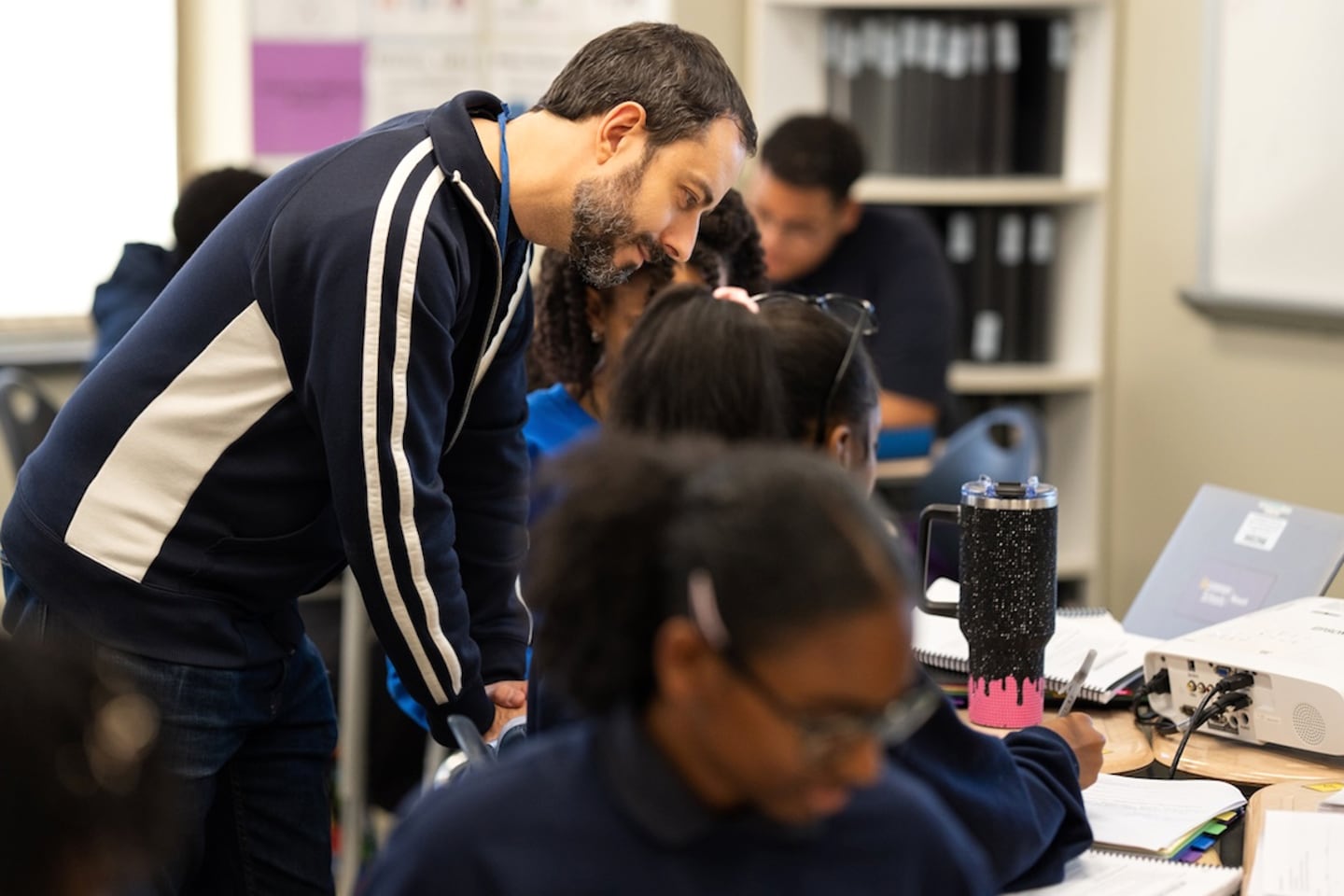
For nearly two decades, Scott Kern has worked to make history feel more alive for Newark students. He does so through close readings of Fredrick Douglass’ Fourth of July speech or, most recently, by weaving artificial intelligence tools into his classroom.
Kern, the AI innovation lead and history department chair at North Star Academy’s Washington Park High School, teaches AP U.S. history to ninth and 11th graders. He joined North Star in 2007 and has spent the last decade at the charter network’s Washington Park campus.
Kern didn’t always envision himself in the classroom. In high school, he enrolled in a world history course instead of orchestra after realizing he had reached his full potential on the violin. That switch set the tone for his career. A standout teacher sparked his fascination for the past and “started a love affair with history that hasn’t abated since,” Kern said.
Now, in his 19th year of teaching, Kern reflected on the lessons that shaped him, why his favorite lesson still surprises him every year, and how AI is influencing what happens inside his Newark classroom.
This interview was edited for length and clarity.
How and when did you decide to become a teacher?
I was certain I would do something with history as a ninth grader. In middle school, I played the violin and was in the orchestra, but it was pretty clear that I had peaked. So I had to meet with my guidance counselor to reconfigure my schedule and replace orchestra. That replacement class happened to be world history. That class and that teacher – Mr. Bentivegna – changed my life and started a love affair with history that hasn’t abated since. I majored in history in college and earned a bachelor of arts, then headed to graduate school to pursue a doctorate in history. One day, when I was at the library working on an esoteric paper for a graduate medieval history class, I started to wonder if this was really what I wanted to do with my life (the answer was “no”). I thought about the people who really changed my life and why, and it was my teachers. After that reflection, I finished my master’s degree, went for yet another master’s degree, and have been teaching history ever since.
What’s your favorite lesson to teach and why?
My favorite is our close reading of a portion of Frederick Douglass’ Fourth of July speech from 1852. I just love everything about it. You have one of the greatest speakers in American history, invited by a group of abolitionist women in New York to give a speech honoring American independence. I try to transport students there. We picture all of these women sitting in their seats and imagining that he is going to thank them and deliver this soaring speech about the Fourth of July and instead, it’s an excoriation. Abolitionists in 1852 are losing – America has just passed a fugitive slave law that endangers all African Americans, including Douglass himself, and slavery is becoming increasingly entrenched in American society.
We zoom out to consider Douglass’s purpose, audience, and word choice. Why would Douglass have come out so intensely in this way? Was this the right message for this audience at this moment in history? What can this tell us about how leaders of social movements try to effect change?
Students are absolutely enthralled every year. We only read a few paragraphs, but they always find something new that surprises. It’s a reminder that history is complicated and beautiful and that we need to bring it to life for students.
What’s something happening in the community that affects what goes on inside your classroom?
Artificial Intelligence is affecting Newark and pretty much every other community in America. I’ve been using AI tools with students for the last two years, such as custom chatbots that I’ve built to help students revise their writing and or debate ideas before class discussions.
The results so far have been really encouraging. Last year, I had my highest AP scores and pass rate ever. I’m also co-teaching an AI literacy class for seniors starting in January and hope to expand it next fall. The goal is not just to teach them how to use these tools, but how to think about them and the world in a humanistic way.
How do you approach news events in your classroom?
We often look at how history echoes the present. Sometimes it’s in the hook and close of class to engage students in the content and then connect it to broader events that will help them see the trends in history.
When we studied the Douglass speech example from earlier, we started off class with pictures of the American flag – one at an ICE protest in L.A. and another from a Fourth of July parade. Students reflected on how the symbol of the flag can evoke different meanings depending on the context. That helped students see how Douglass and his audience could experience the same holiday in very different ways.
Tell us about your own experience with school and how it affects your work today.
I was an underachiever and a procrastinator for a long time. Some great teachers tried to pull me along, but it never clicked for me. That experience makes me hyper-aware of students who are capable but aren’t intrinsically motivated. If my teachers had let me just float in that state, my life would be very different. I’d like to think I’m doing the same thing – trying to nudge students along to reach their potential.
What’s the best advice you’ve ever received, and how have you put it into practice?
The best advice I ever got was from my father, who encouraged me to be committed to whatever I chose to do. That has framed much of my life since. I knew I wasn’t going to be the smartest or the fastest at anything, but I could control my effort. Over time, I was determined to commit to things and try to out-hustle everyone else. Teaching isn’t a competition, but it has required extraordinary levels of commitment over the years. I credit my father for instilling that drive in me.
What’s one thing you’ve read that has made you a better educator?
Reading Zaretta Hammond’s “Culturally Responsive Teaching and the Brain” felt like a strong pedagogical approach to teaching that I believed in and had seen in class. Her explanation of how the brain’s amygdala shuts down when threatened makes higher-order learning nearly impossible. When students feel threatened, their brains shut off the ability to do meaningful learning. It spoke to me deeply and reinforced my belief that a physically and intellectually safe environment is important for meaningful learning.
How do you take care of yourself when you’re not at work?
Friends and family are my priority outside of work. We have family rituals that keep me grounded. Family dinner at the table with no devices is obligatory except on Friday, which is movie night. We spread a blanket on the floor for our kids, and we have dinner and a movie together. I also try to get together with a group of friends at least once a week, usually to play board games. I love that board games bring people together in an analog way that promotes dialogue and human connection.
Jessie Gomez is a reporter for Chalkbeat Newark, covering public education in the city. Contact Jessie at jgomez@chalkbeat.org
