


To feel enthusiastic about their jobs, teachers need to know their school and district leaders will listen to their practical concerns—and stick around long enough to address them.
While Education Week’s 2025 State of Teaching survey found teacher morale rising nationwide, Massachusetts and some of its neighbors have seen falling enthusiasm for the profession among educators.
Classroom teachers and district and school leaders discussed ways to boost teacher morale amid tightening district budgets and other pressures at a symposium on the State of Teaching held here Dec. 4 by Education Week and the Boston Globe.
Teachers at the forum said that flexibility in the workplace can matter as much to educators as compensation. Even though Massachusetts teacher salaries are among the highest in the country, the cost of living often prices teachers out of the communities in which they teach or requires them to pick up second jobs.
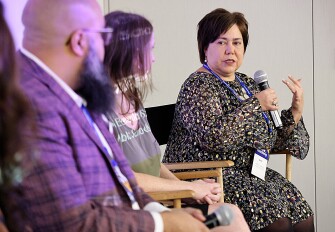
“Historically, teaching was viewed as a very flexible job. But I think there’s been a shift [in perception] now that there’s much more remote work and more flexibility—because teaching is not very flexible,” said Luisa Sparrow, a mom of two and special education teacher at Oliver Hazard Perry School, and a recent recipient of a Massachusetts Teacher of the Year honor. Sparrow was speaking on a panel at the event that looked at teacher morale, and ways districts and schools can support educators.
“You have to be there at certain hours, and my child is like the last kid at daycare pickup every single day. … It feels tough to be providing a service for other families that then makes it hard for me to pick up my own children on time every day.”
Almi Abeyta, superintendent of Chelsea, Mass., public schools and another panelist, comes from a family of educators who have kept her in touch with the practical realities of the profession.
“When I got into teaching in my early 20s, I remember my aunts and my mother … they’re like, ‘oh, why? You’re going to be tired by the time you’re 50; you’re not going to make enough and you’re not going to be able to pay your bills.’ This was the reality in my family,” Abeyta said.
“So as a superintendent, I’m always thinking of how do I shelter [teachers]? How do I make sure that we’re providing the best supports?”
Since 2019, Chelsea has boosted teacher and paraprofessional pay, and it also increased family leave for teachers with children of their own, Abeyta said.
Sujan S. Talukdar, the principal of Underwood Elementary School in Newton, Mass., said she works to provide free and low-cost professional development programs to help her teachers gain new credentials.
“We have so many talented people. We’re thinking about, how do we connect them to those resources and opportunities that ultimately allow them to grow professionally and, over time, earn more financially?” Talukdar said.
She hopes that if teachers can afford to live in the communities where they work, “their professional careers can be extended and grown over time,” the principal added. “They will feel happier and … they will then be able to contribute in so many different ways within our school community.”
Teacher labor disputes and strikes have emerged in Massachusetts and nationwide in the last five years, and both administrators and educators at the Boston event emphasized the need for better collaboration.
“The teachers’ working environment is the student learning environment,” said Serge Moniz, a teacher and union leader at the Greater New Bedford Regional Vocational Technical High School. “So we are mindful when we are bargaining for certain things to make sure that we’re not being selfish, looking at what do we want just to make our lives easier, [without knowing] the true impact for our students.”
Steady leadership a must
Leadership stability is also crucial to teacher morale, the panelists said.
“This is my ninth year [teaching in Boston public schools], and I think this is my fourth superintendent and my fourth principal,” Sparrow said. “It’s just tough adjusting to different plans, different visions … and it feels like once you have enough time to get your sea legs in a certain direction, then something different comes along.”
Sparrow’s not alone. Nationwide, turnover among both principals and superintendents has risen since the pandemic.
The School Superintendents Association, or AASA, found that from 2000 to 2023, the share of district leaders who had served their current school system six years or more fell from 66.6% to just over 52%. Nearly a quarter of the nation’s 500 largest school districts had a superintendent turn over in 2024 alone. Some research has found that student achievement dips in the years following a superintendent’s departure.
The consequences are real for principal turnover, too. Studies find teachers tend to have higher job satisfaction and lower turnover in schools with more tenured principals.
Longer-established leaders get better at hiring teachers who will stick around, too. A study of Texas school principals found it takes seven years in a school for a principal to become most effective at choosing teachers who will stay in the school for five years or more. Principals’ hiring effectiveness goes down when they move to a new school.
Abeyta, who has led the Chelsea district since 2019, and Talukdar, Underwood’s principal since 2018, said their tenure has given them more time to build relationships with their teachers. Both have worked to build pipelines to train and encourage their veteran educators to become administrators, too.
“The competing and growing demands on teacher time have become more and more evident,” Talukdar said, “so I’m really thinking about, how do we continue to build community support and care amongst the adults in the building so that they know that they can turn to each other as resources, to vent, [when they] need a break.”
Most of all, teachers need opportunities to collaborate and support each other, said Moniz.

“Ultimately we all have a little bit of responsibility for our joy in our teaching experience,” said Moniz, who launched a support group for male teachers of color and regularly attends formal and informal professional development. “You have to put yourself in these spaces where you can bring that joy back into yourself.”
