


Priti GuptaTechnology Reporter

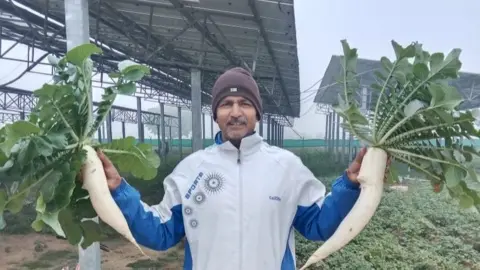 Harpal Dagar
“As a farmer, you’re always at the mercy of weather,” says Harpal Dagar who has a farm on the outskirts of Delhi.
“So many times, we lost our produce due to unpredictable conditions,” he says.
But five years ago he was approached by Sun Master, a Delhi-based solar power firm, with a deal that would give him a much more predictable income.
Sun Master proposed building solar panels above some of Mr Dagar’s fields, with the panels high enough off the ground, that he could continue to farm underneath them.
Under the 25-year deal, Mr Dagar would receive annual payments and Sun Master would keep the proceeds from the electricity generated.
“When the solar company first approached us… many of us feared losing our land. It sounded too good to be true – maybe even a scam,” says Mr Dagar.
“But today, I believe it was the best decision I made. My income has tripled, and I sleep peacefully without the stress of climate or crop failure,” he says.
Sun Master pays him around $1,200 (£900) per acre, per year, plus $170 a month for work operating and maintaining the solar panels.
“Even the turmeric I grow on the same land is mine to sell. How can I complain?”
Siting solar panels above crops goes by the term agrivoltaics.
India would seem particularly suited to such innovation. The fortunes of many of its farmers often hinge on an unpredictable monsoon, so a reliable income from a solar energy firm might provide some welcome financial security.
But despite the benefits, take up has been slow, around 40 projects are operating in India at the moment, according to the National Solar Energy Federation of India (NSEFI), which represents India’s solar power industry.
There are several challenges.
Not all crops will grow under solar panels. Depending on the layout, the panels reduce the light getting through by between 15% and 30%. Some denser layouts will block too much sun for staple crops including wheat, rice, soybeans or pulses.
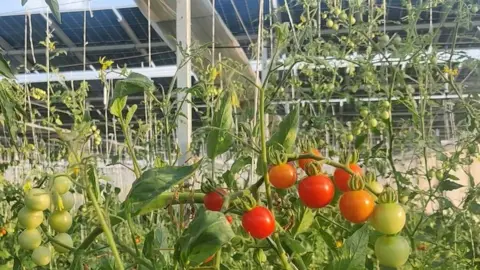
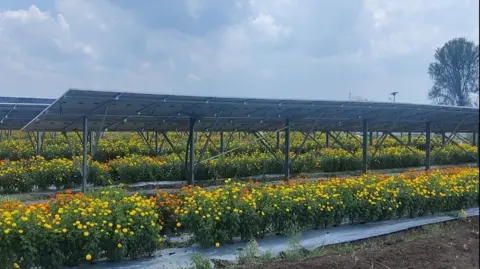
“What works well are high-value crops with moderate or low-light needs, like green leafy vegetables, spices such as turmeric and ginger, and some flowers,” says Vivek Saraf, the founder and CEO of Delhi-based SunSeed, which specialises in agrivoltaics.
There’s also the issue of expense.
To allow farming underneath, the solar panels need to be at least 11ft (3.5m) off the ground. That makes them between 20% and 30% more expensive to install than panels on a regular solar farm, where they are much closer to the ground.
“Small farmers cannot own these systems. They don’t have the risk appetite or capital,” says Mr Saraf.
 SunSeed APV
The solar power companies want the government to step in with subsidies to make agrivoltaics more attractive.
“In India, where more than 55% of the population depends on agriculture and cultivable land is under mounting pressure, agrivoltaics offers a transformative model,” says Subrahmanyam Pulipaka, CEO of NSEFI.
“It reduces irrigation needs, shields crops from heat stress, and stabilizes incomes by diversifying revenue streams for farmers. For rain fed and climate-vulnerable regions, agrivoltaics can play a vital role in climate adaptation, making agriculture more resilient to unpredictable weather patterns,” he says.
SunSeed gives the farmer multiple options, including continuing to farm for a fixed salary, or handing over all the farming responsibility to SunSeed.
“Our model ensures the farmer is not exposed to any risk. If the crop fails or there’s a market issue, the loss is ours – not the farmers’,” he says.
Meanwhile, SunSeed has been finely tuning its system to work with different crops and conditions.
“We have developed sophisticated agrivoltaics simulation software,” he says.
“It digitally replicates panel configurations and crop types to simulate how much light and heat each leaf receives, how photosynthesis is affected, and ultimately how much yield to expect.”
 SunSeed
There’s still caution in government circles over the combination of solar power and farming.
“Agrivoltaics is promising, but we must protect both the farmer and the developer,” says Manu Srivastava, who oversees solar and agrivoltaic projects in the state of Madhya Pradesh.
“The biggest challenge is contracts. A 25-year lease needs clear obligations and protection for both sides. In India, long-term contract enforcement is still a hurdle,” says Mr Srivastava.
He also points out that agrivoltaics systems are more expensive than a traditional ground-mounted solar farm, so making a return on the investment is more challenging.
“If the farmer starts charging too much for land and the developer has to bear high structural costs, then it becomes unviable,” he says.
At the moment India is falling behind China, where more than 500 projects are in operation, according to the World Resources Institute.
“It’s a small beginning. But if the farmer’s economic interest is protected, if the right crops are chosen, and if contracts are clear and fair, there’s no reason India can not lead in agrivoltaics,” says Mr Srivastava.
 Anand Jain
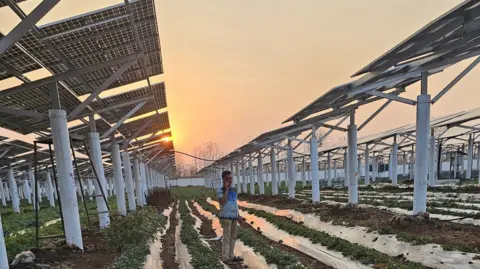
Anand Jain comes from a family of farmers. He was growing medicinal herbs, but in 2024 he found a plot of land with no electricity.
“That’s when the idea clicked. Necessity is the mother of invention, and that’s how I began experimenting with agrivoltaics.”
Today he has 14 acres of farmland under solar panels. The farm has a total generation capacity of 4.5 megawatts, about the same as a medium-sized wind turbine.
Underneath he is still experimenting with crops, he hasn’t sold any at the market yet but says the quality is “promising”.
“I’ve had success with strawberries and tomatoes, although cauliflower didn’t work out as well.”
The project was funded with bank loans and support from the government, in all an investment of $2.27m.
“Let me be clear – agrivoltaics isn’t yet feasible for small farmers in India,” he says.
“This model will only succeed if there is a strong partnership between the government and the private sector.”
